Here's What Every Business Owner Needs to Know
Something quietly significant happened last week that most businesses and, honestly, a lot of SEO professionals completely missed.
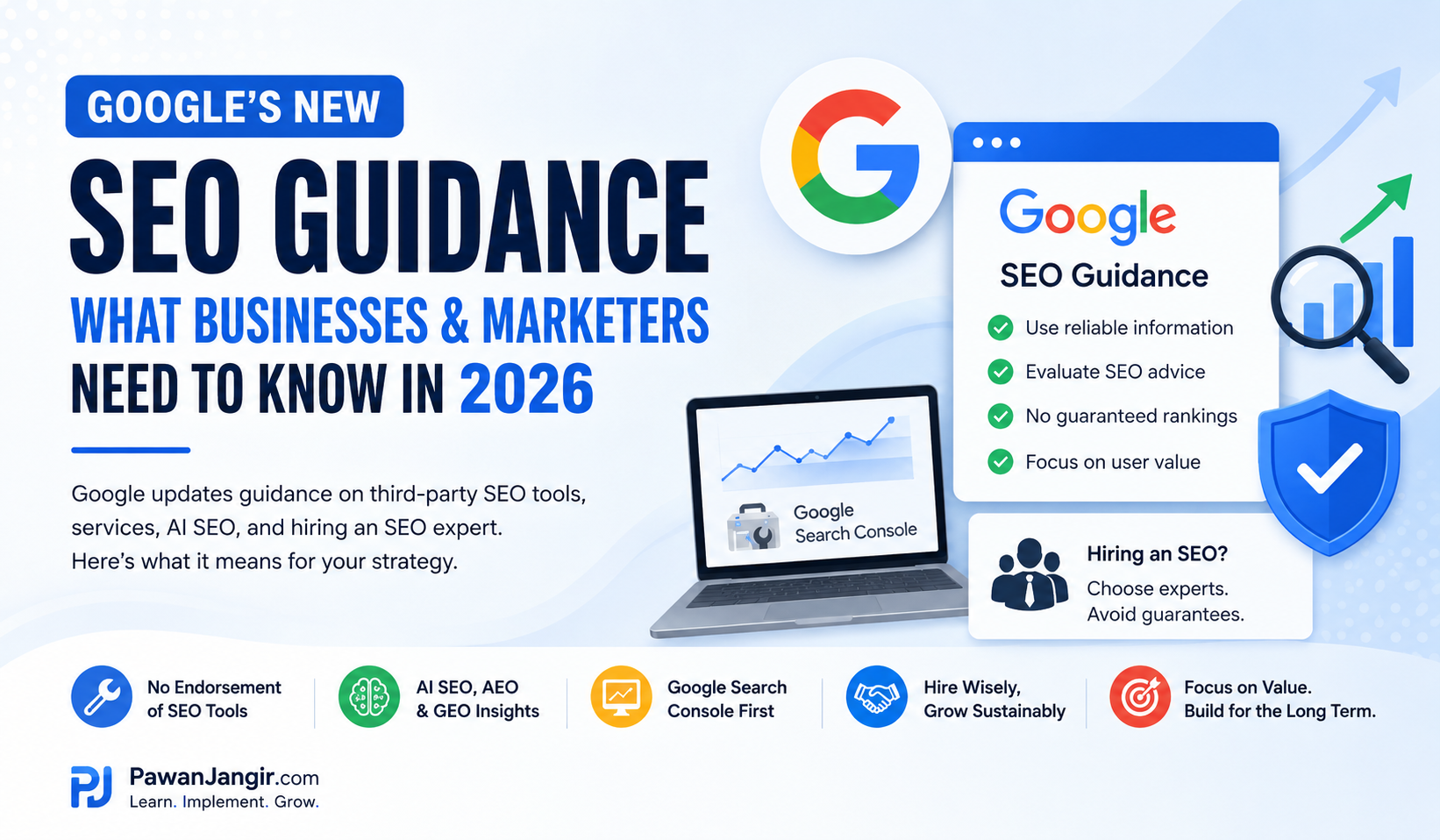
On June 7, 2026, Google added a brand-new help document to its official Search Developer documentation titled “Google Search’s guidance on using third-party SEO tools, services, and advice.” They also updated their older “Do you need an SEO?” document at the same time.
This isn’t routine housekeeping. Google updating its foundational SEO guidance, especially to specifically address third-party tools, AEO, and GEO is a signal worth paying close attention to.
Let me break down what changed, what it means, and what you should actually do about it.
What Google Changed (And Why)
Google stated the reason for these updates plainly: to “highlight important considerations when evaluating third-party SEO tools and advice, and to simplify some sections and remove outdated examples in existing documentation.”
In other words, too many businesses are being sold SEO tools and services that make promises Google itself cannot validate. Google decided it was time to say so officially.
The Big One: Google Does Not Endorse Any Third-Party SEO Tool
This point deserves to be read twice.
Google has explicitly stated in its new documentation that it does not evaluate or endorse any third-party SEO tool. If you’ve ever seen a tool marketing itself as “Google-approved” or “accepted by Google Search” that claim is false. Google is now directly warning businesses against falling for it.
More importantly, Google has confirmed something that I tell my clients all the time: third-party tools do not have access to Google’s internal ranking data. They can surface patterns, estimates, and correlations but they cannot guarantee ranking performance. No tool can. No consultant who relies purely on tools can either.
This applies across the board to tools that help with sitemap generation, indexing directives, content generation, rank improvement advice, and yes, tools making promises around AI-based search experiences.
The AEO and GEO Call-Out Is Especially Important
This is where things get very interesting for 2026.
Google specifically called out tools and services promising improvements for AI experiences and search formats, the very services being marketed as AEO (Answer Engine Optimization) and GEO (Generative Engine Optimization) tools.
The AI search space is growing fast. ChatGPT, Gemini, Perplexity, AI Overviews: everyone wants visibility in these surfaces. And predictably, a wave of tools and agencies have emerged promising to “optimize” your content for AI answers. Some of these are legitimate. Many are not.
Google’s updated “Hiring an SEO” document now asks businesses to critically evaluate whether the AEO/GEO advice they’re receiving aligns with Google’s official guidance on optimizing for generative AI features. If your current SEO provider is pitching you GEO services without referencing Google’s own documentation on the topic, that’s a red flag worth taking seriously.
As someone who offers GEO and AEO as part of my service stack, I welcome this clarity. Clients deserve to know which strategies are grounded in Google’s actual guidance and which ones are built on speculation.
What Google Now Expects From Your SEO Provider
Google’s updated “Do you need an SEO?” document spells out a useful checklist for evaluating whoever is managing your SEO whether that’s an agency, a freelancer, or a tool doing automated audits. Here’s what Google now advises you to verify:
1. Do their recommendations reference official Google documentation? Any serious SEO recommendation should be traceable back to Google’s own guidelines. If your provider is citing “industry best practices” without pointing to Google’s Starter Guide, Search Central, or official documentation, ask why.
2. Are their AEO/GEO recommendations aligned with Google’s AI optimization guidance? This is new and it matters. The rules for appearing in AI Overviews, featured snippets, and generative AI results are specific. Generic content advice won’t cut it.
3. Are the tools they use consistent with Google’s guidance? This isn’t about which tool is “best” — it’s about whether the outputs from those tools are being cross-referenced against what Google actually values.
4. On SEO audits, specifically be careful about access. Google now explicitly advises: if an SEO offers to audit your site, only grant read access to Google Search Console at that stage not write access. A legitimate audit gives you realistic estimates and a clear scope of work. Anyone guaranteeing first-page rankings upfront is a signal to walk away.
The One Tool Google Trusts: Search Console
Amidst all the caution about third-party tools, Google pointed to one source it stands behind completely, Google Search Console. It provides, as Google puts it, “key information and data directly from Google Search itself.”
If you’re working with an SEO professional who isn’t making Search Console the foundation of your reporting and strategy, that’s worth questioning. Everything else Ahrefs, SEMrush, Moz, Screaming Frog, these are excellent supporting tools. But Search Console is the only one with a direct line to how Google sees your site.
What This Means If You’re a Business Looking to Hire SEO Help
Google’s update is essentially a buyer’s guide in disguise. Here’s how I’d translate it into practical decision-making:
- Ask for specific Google documentation to back up any major recommendation. A good SEO can point to exactly why they’re suggesting what they’re suggesting.
- Be skeptical of ranking guarantees. Google’s own documentation says: if they guarantee first place, find someone else.
- AEO and GEO services should have a strategy grounded in official guidance, not just a tool that scans your site and spits out a score.
- Search Console access should be read-only until you’ve completed an audit and decided to move forward with a provider.
- No third-party tool is endorsed by Google. The value is in the expertise of the person interpreting the data, not the data itself.
My Take: Why This Update Is Good for the Industry
I’ve been doing digital marketing for over 13 years. In that time, I’ve seen a lot of tools come and go, a lot of tactics overhyped, and a lot of clients burned by providers who sold dashboards and PDFs instead of real results.
Google’s move here is overdue and welcome. The SEO industry has always had a credibility problem too many people selling certainty in a space where nothing is guaranteed. By officially documenting that third-party tools cannot guarantee rankings and that AI optimization claims need to be grounded in official guidance, Google is raising the bar for the entire profession.
For my clients, nothing changes this is how I’ve always operated. But for anyone evaluating SEO or AI search services, this document gives you a framework to ask better questions and spot the difference between genuine expertise and well-packaged noise.
Key Takeaways
- Google published a new document specifically addressing third-party SEO tools and services in June 2026.
- Google does not endorse any third-party SEO tool, and no tool has access to Google’s internal ranking data.
- AEO and GEO tools making promises about AI search visibility are specifically called out their advice must align with Google’s official AI optimization guidance.
- When evaluating an SEO or their tools, check whether their recommendations cite official Google documentation.
- Google Search Console remains the only direct, Google-endorsed source of ranking data.
- Grant only read access to Search Console during an audit phase.