
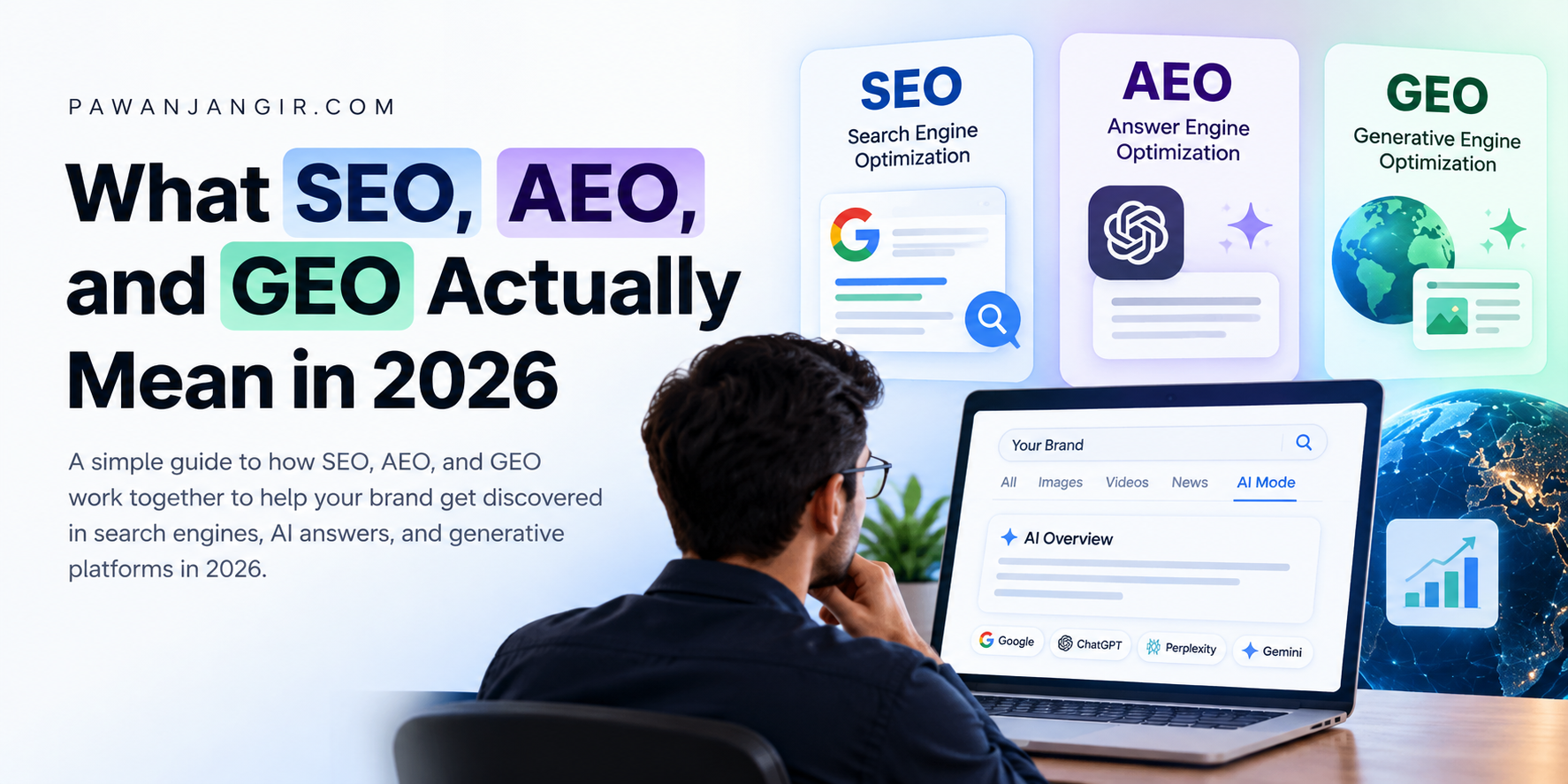
Search has split into three overlapping disciplines in 2026: ranking in traditional results (SEO), being pulled into direct answers and featured snippets (AEO), and getting cited inside AI-generated responses from ChatGPT, Perplexity, Gemini, and Google AI Overviews (GEO). They share one foundation content that is genuinely useful, well-structured, and trustworthy, but each has its own execution details. Below is the full activity list, the process to follow, and a repeatable SOP you can apply to any website or client.
What SEO, AEO, and GEO Actually Mean in 2026
SEO (Search Engine Optimization) still drives the majority of organic traffic. It’s about technical health, keyword-to-intent matching, topical depth, and earned backlinks. The fundamentals haven’t disappeared; they’ve just stopped being sufficient on their own.
AEO (Answer Engine Optimization) is about structuring content so a machine can lift out a direct answer for featured snippets, voice search, and “People Also Ask” boxes. The core discipline: put the answer close to the question, in plain, extractable language.
GEO (Generative Engine Optimization) is about earning a citation inside an AI-generated answer. This depends less on ranking position and more on whether the AI model trusts your content enough to quote or reference it. AEO has largely become a subset of GEO, the same direct-answer formatting that helps snippets also helps AI citations.
The practical implication: you no longer optimize for a click. You optimize for reference rate how often you get cited or shown alongside traditional rankings.
The Complete Process: Step-by-Step SOP
Step 1: Technical Foundation Audit
Before any content work, confirm the site is fully crawlable and readable by both search bots and AI crawlers.
- Check crawlability and indexation in Google Search Console (coverage report, sitemap status)
- Confirm Core Web Vitals are within an acceptable range (LCP, INP, CLS)
- Audit robots.txt and llms.txt. Many AI crawlers (GPTBot, ClaudeBot, PerplexityBot) now check for explicit permission signals
- Verify mobile rendering and page speed, since a slow or broken page won’t get crawled deeply enough to be understood
- Fix duplicate content, broken links, and orphaned pages that dilute topical signals
Why it matters: neither a search engine nor an LLM can rank or cite what it can’t properly crawl and parse.
Step 2: Keyword & Intent Research
- Map keywords to actual search intent (informational, commercial, transactional, navigational) rather than just search volume
- Identify question-based queries your audience asks; these are the backbone of AEO
- Research what AI Overviews and chat tools currently say for your target queries, so you know what gap your content needs to fill
- Group keywords into topic clusters instead of one-keyword-per-page thinking; topical depth outperforms keyword density in 2026
Step 3: Content Creation for SEO + AEO + GEO Together
This is where most of the actual work happens, and it should serve all three disciplines with one well-built page rather than separate content for each.
- Lead with the answer. Place the core answer to the primary question within the first 100–150 words, before going deeper. Both AEO and GEO reward this pattern heavily.
- Use question-based subheadings. Structure H2/H3 tags as the actual questions people ask, followed immediately by a concise, self-contained answer.
- Make each section stand alone. An AI model often extracts a single paragraph out of context, so that the paragraph makes sense in isolation.
- Add specificity and original data. Numbers, first-hand results, screenshots, or test outcomes are hard for AI (or competitors) to fake and are exactly what raise citation probability.
- Avoid generic filler. Content that just repeats what’s already ranking gets ignored by both classic ranking systems and generative models, which are trained to prefer non-redundant, original framing.
- Use tables, numbered lists, and comparison formats wherever data or steps are involved they’re the easiest structures for AI systems to extract cleanly.
Step 4: Structured Data & Schema Implementation
Structured data is arguably the single highest-leverage technical activity for AEO/GEO in 2026, since LLMs lean on it even more heavily than traditional crawlers.
- Implement sitewide
OrganizationandWebSiteschema - Add entity-appropriate schema per page type:
Article,FAQPage,Service,Product,Event,HowTo - Keep schema and visible content in sync mismatched schema is a trust red flag
- Validate everything with Google’s Rich Results Test and Schema Markup Validator
Step 5: E-E-A-T & Trust Signal Build-Out
Google’s own quality framework, Experience, Expertise, Authoritativeness, Trustworthiness, has become the backbone of both classic rankings and AI citation trust in 2026, especially after the core updates that specifically targeted low-effort AI content.
Experience
- Show first-hand involvement: original photos, screenshots, personal test results, specific dates and outcomes
- Avoid content that reads as pure research summary with no direct engagement with the topic
Expertise
- Publish under named, credentialed authors with a real bio, not “Admin” or no byline at all
- Link author bios to verifiable credentials (LinkedIn, certifications, past work)
- Have subject-matter experts review or sign off on technical content
Authoritativeness
- Earn backlinks and mentions from relevant, reputable sources relevance matters more than volume
- Build unlinked brand mentions through digital PR and thought leadership; AI models weigh brand consensus across the web, not just links to your domain
- Get cited or quoted in industry publications
Trustworthiness
- Cite primary sources and official documentation for factual claims
- Keep NAP (name, address, phone), pricing, and service details identical across your site, Google Business Profile, and directories inconsistency creates “noise” that reduces AI confidence in your facts
- Maintain a visible editorial/correction policy and update outdated content proactively
- Add “last updated” dates, especially on evergreen and YMYL-adjacent content
Step 6: Off-Page Authority Building
- Digital PR outreach to earn editorial placements on authoritative outlets
- Guest contributions or expert quotes in industry roundups
- Co-created content or data partnerships with complementary businesses
- Consistent, monitored brand mentions across review platforms and directories
Step 7: AI Visibility Monitoring
Traditional rank tracking no longer tells the whole story. Add a layer specifically for GEO:
- Track how often and in what context your brand is cited across ChatGPT, Perplexity, Gemini, and Google AI Overviews for your priority queries
- Compare your citation rate against competitors on the same queries
- Note which page format or content type is actually getting cited, and reverse-engineer that pattern into future content
Step 8: Maintenance & Refresh Cycle
- Re-audit top-performing and declining pages quarterly
- Refresh statistics, screenshots, and examples. Stale content is a trust signal problem, not just an SEO one
- Re-check schema and structured data after any site redesign or CMS update
- Review Search Console and AI-visibility tools monthly for early signals of ranking or citation drops
Quick-Reference EEAT Checklist
- Named author with a real, verifiable bio on every piece of content
- First-hand experience shown through original media, data, or specific outcomes
- Primary sources cited for factual or statistical claims
- Consistent business facts (NAP, pricing, services) across the entire web presence
- Visible editorial and correction policy
- Content reviewed and updated on a fixed schedule, not left untouched for years
- No exaggerated or unsupported claims; uncertainty stated honestly where it exists
Monthly SOP Snapshot
| Frequency | Activity |
|---|---|
| Weekly | Monitor Search Console for crawl errors, indexing issues, and ranking movement |
| Weekly | Track AI citation visibility for priority queries |
| Monthly | Publish new topic-cluster content with a question-based structure and schema |
| Monthly | Digital PR / outreach for new backlinks and brand mentions |
| Quarterly | Full content refresh pass on top and declining pages |
| Quarterly | Technical audit Core Web Vitals, schema validation, crawlability |
| Annually | Full E-E-A-T and author authority audit across the site |
The One Principle That Ties It All Together
Write for a real reader first. The same page that satisfies a human reader, a search crawler, and an AI model at once is the one that wins across SEO, AEO, and GEO simultaneously because all three are ultimately scoring the same thing: is this genuinely useful, credible, and clear. Chasing tricks for one channel at the expense of real usefulness tends to fail across all three at once.