
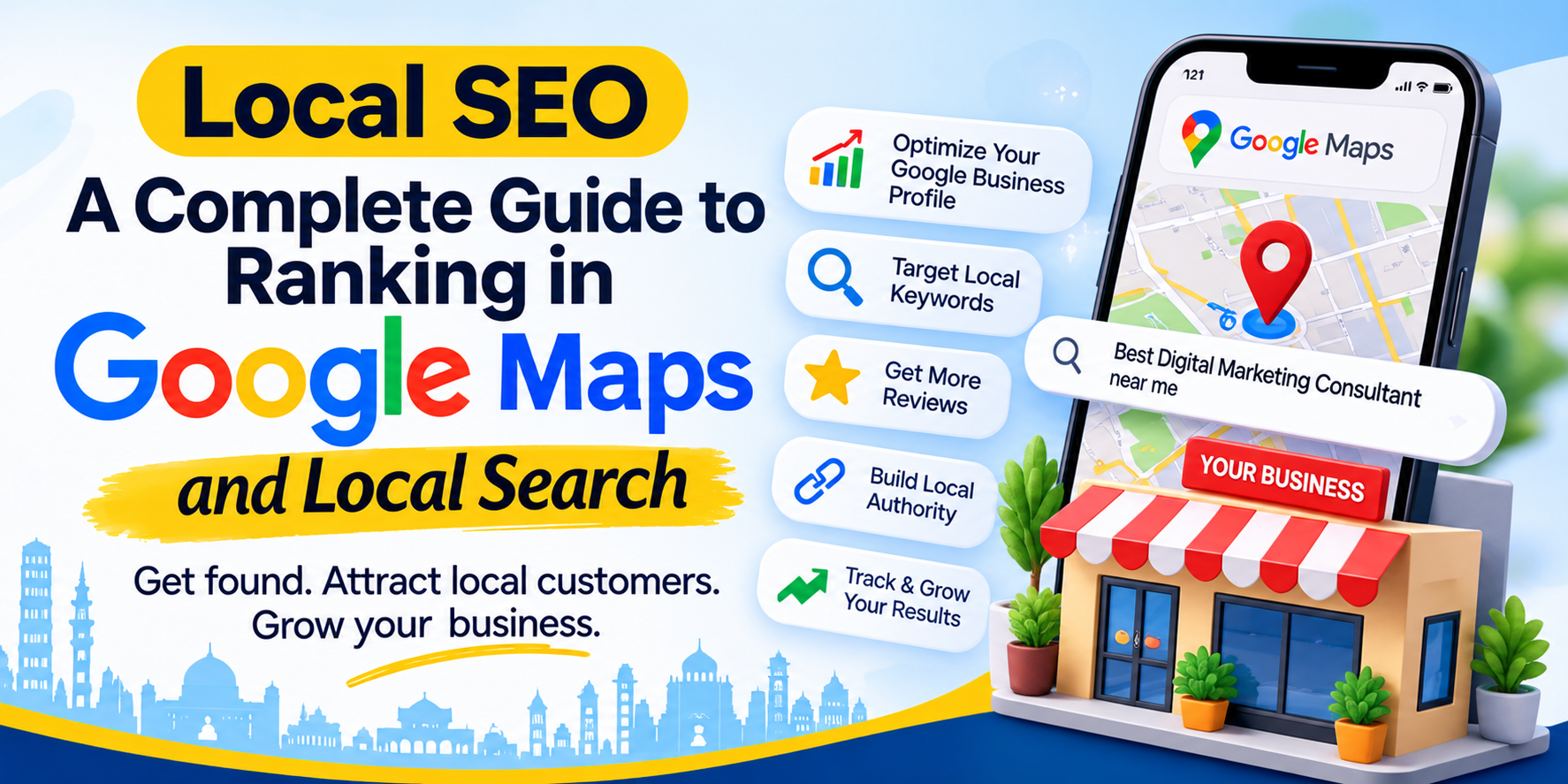
Local SEO: A Complete Guide to Ranking in Google Maps and Local Search
When someone searches for a service near them, they usually have a specific need. They may be looking for a dentist, a digital marketing agency, a plumber, a restaurant, or a shop they can visit today.
These searches create an opportunity for businesses to connect with people who are already interested in their products or services.
However, having a website and a Google Business Profile does not automatically mean your business will appear at the top of local search results. Your competitors may have stronger local relevance, better-established reputations, more useful websites, or business profiles that provide more complete information.
This is where local SEO becomes important.
Local SEO helps businesses improve their visibility in location-based search results, including Google Search and Google Maps. When implemented properly, it can help potential customers discover your business, call you, request directions, visit your website, or book an appointment.
In this guide, I’ll explain how local SEO works, how to optimize your Google Business Profile, how to find local keywords, how to build local authority, and how to measure the results of your efforts.
Whether you run a local shop, a service-area business, a professional practice, or a multi-location company, this guide will help you develop a practical local SEO strategy.
Table of Contents
What Is Local SEO?
Why Local SEO Matters
How Local SEO Works
Understanding Google’s Local Ranking Factors
Google Business Profile Optimization
Local Keyword Research
On-Page SEO for Local Businesses
Location Pages and Website Structure
Local Citations and Business Information Consistency
Reviews and Online Reputation Management
Local Link Building
Local Content Marketing
Technical SEO for Local Search
Local SEO for Service-Area Businesses
Local SEO for Multiple Locations
Local SEO for E-commerce and Hybrid Businesses
Common Local SEO Mistakes
Best Local SEO Tools
A Practical Local SEO Audit Checklist
How to Measure Local SEO Performance
A 90-Day Local SEO Action Plan
Frequently Asked Questions
Final Thoughts
1. What Is Local SEO?
Local SEO, or Local Search Engine Optimization, is the process of improving a business’s visibility in search results for queries connected to a particular geographic area.
For example, consider these searches:
Digital marketing consultant in Jaipur
Best dentist near me
AC repair service in Vaishali Nagar
Italian restaurant in Dubai Marina
Plumber open near me
SEO agency in London
These searches indicate that the person is looking for a business or service connected to a location.
Local SEO helps search engines understand what a business offers, where it operates, and how relevant it is to a particular search.
Unlike traditional SEO, which may target a broad national or international audience, local SEO often focuses on attracting customers from a specific city, neighborhood, or service area.
What does local SEO include?
Local SEO involves several connected activities:
Google Business Profile optimization.
Local keyword research.
Website content optimization.
Location and service pages.
Local business citations.
Review generation and reputation management.
Local link building.
Technical SEO and structured data.
Performance tracking through analytics and search reporting.
These activities work together. A well-optimized business profile can improve your local presence, while a useful website can explain your services in greater detail and help convert visitors into customers.
Local SEO is not limited to businesses with a physical storefront. Certain businesses that travel to customers can also qualify for a Google Business Profile, provided they meet Google’s eligibility guidelines.
The right strategy depends on how your business operates, where you genuinely serve customers, and what your potential customers are searching for.
2. Why Is Local SEO Important for Businesses?
Imagine someone searching for “emergency plumber in Jaipur.” They are unlikely to spend hours reading general plumbing articles. They want a reliable service provider who can help them.
If your plumbing business appears prominently for a relevant local search, the person may call you directly.
This is one of the main advantages of local SEO: it helps businesses reach people when their location and service requirements are relevant to the search.
Key benefits of local SEO
1. Better visibility in local search
A well-maintained Google Business Profile and an optimized website can help your business become more discoverable in relevant local searches.
2. More qualified leads
Local searches can reveal a person’s interest in a specific service and location. This can help attract visitors who are more likely to become customers, although actual conversion rates depend on the business and the search.
3. Increased calls and enquiries
Your Google Business Profile and website can make it easier for potential customers to find your phone number, visit your website, request directions, or contact your team.
4. Stronger local credibility
Accurate business information, genuine reviews, useful content, and a consistent online presence help customers evaluate whether your business is trustworthy.
5. Better understanding of customer demand
Local keyword research can reveal the services, locations, and questions that matter to your audience. This information can support your wider marketing strategy.
6. Long-term marketing value
Unlike a paid campaign that stops generating paid exposure when its budget runs out, organic visibility can continue to bring relevant visitors over time. However, local rankings require ongoing maintenance and are never guaranteed.
For small businesses, local SEO can be a practical way to compete for relevant searches without relying entirely on advertising.
3. How Does Local SEO Work?
Local search results appear in different formats depending on the query, device, location, and search context.
A user searching for a nearby restaurant might see a map with business listings before the traditional organic results. Someone searching for a specific company’s name may see its website, contact details, and business information.
There are two major areas to consider.
Google Maps and the local pack
The local pack is a group of local business listings that may appear prominently in Google Search, often alongside a map.
A listing may display information such as:
Business name.
Primary category.
Review rating and review count.
Address or service-area information.
Opening hours.
Phone number.
Website link.
Directions or other available actions.
The exact presentation varies.
Traditional organic search results
These are the regular website listings that appear in search results.
For example, a user searching for “local SEO consultant in Jaipur” might see service pages, consultant websites, agency pages, or relevant articles.
A business can work on both its Google Business Profile and its website to improve its local search presence.
However, ranking in Google Maps and ranking in traditional organic results are not identical processes. A business may perform well in one area and less well in the other.
This is why a complete local SEO strategy should not focus exclusively on Google Business Profile optimization.
4. Understanding Google’s Local Ranking Factors
Google explains that local results are primarily based on three factors: relevance, distance, and prominence.
These are the main concepts businesses should understand before investing time in local optimization.
Relevance
Relevance describes how closely a business matches what someone is searching for.
Suppose someone searches for “orthodontist in Jaipur.” A dental clinic that offers orthodontic services is more relevant to that query than a business that only provides unrelated services.
You can improve relevance by:
Selecting an accurate primary business category.
Providing complete business information.
Clearly explaining your services.
Maintaining useful service pages on your website.
Keeping your business hours and contact details accurate.
Publishing content that genuinely answers relevant customer questions.
The objective is not to insert every possible keyword into your business description. It is to make your actual services clear.
Distance
Distance refers to how far a business is from the searcher or the location specified in the query.
For example, someone searching for “coffee shop near me” may see different results depending on where they are standing.
This is an important distinction because businesses cannot control where every searcher is located.
Adding more city names to your website will not make a business physically closer to a customer. Nor does creating multiple artificial listings solve the distance problem.
Instead, focus on accurately representing your location and serving the areas where your business genuinely operates.
Prominence
Prominence describes how well-known a business is.
Google indicates that prominence can be informed by factors such as information about the business across the web, links, and reviews.
Businesses can work on prominence by:
Earning genuine customer reviews.
Building relationships with relevant local organizations.
Getting mentioned by reputable local publications.
Earning relevant links from trusted websites.
Maintaining a useful and credible online presence.
Publishing content that demonstrates genuine expertise.
There is no publicly disclosed formula that lets you calculate exactly how these factors are weighted for every search.
Google also does not offer a legitimate way to pay for a better organic local ranking.
You can read the official guidance in Google’s tips to improve local ranking.
5. Google Business Profile Optimization
Google Business Profile is one of the most important assets for eligible local businesses.
It allows businesses to manage how their information appears on Google Search and Google Maps.
A properly maintained profile helps potential customers understand what the business does, where it operates, and how they can contact it.
However, creating a profile is only the beginning. It must accurately represent the real business.
Step 1: Claim and verify your profile
If your business is eligible and you have not claimed its profile, start by visiting Google Business Profile.
Follow the verification process offered for your business.
Verification establishes that you are authorized to manage the profile. It does not guarantee a particular ranking.
Step 2: Use your real business name
Your business name should match the name you use in the real world.
Avoid adding unnecessary keywords, locations, or promotional phrases to the business name merely to influence rankings.
For example, if your business is officially called “ABC Dental Clinic,” changing the name to “ABC Dental Clinic Best Dentist Jaipur Affordable Dental Implants” can violate Google’s guidelines if that is not the genuine business name.
Keyword stuffing in business names can create profile quality problems and may lead to enforcement.
Step 3: Choose the correct primary category
Your primary category should describe the main type of business you operate.
A dental clinic should choose an appropriate dental category. A restaurant should select the category that most accurately reflects its operation.
Add secondary categories only when they genuinely represent the business.
Do not select categories solely because they contain keywords you want to rank for.
Step 4: Complete the business information
Review the following fields:
Business name.
Primary and relevant secondary categories.
Address, where eligible.
Service areas, where applicable.
Phone number.
Website.
Business hours.
Special holiday hours.
Services and products, where supported.
Business description.
Relevant photos and other available profile features.
Complete the information accurately and update it when something changes.
Step 5: Write a useful business description
Your description should explain what your business does, who it serves, and what customers can expect.
For example, a digital marketing consultant might write:
“We help businesses improve their online visibility through SEO, performance marketing, website optimization, and digital growth strategies. Our approach focuses on understanding business goals, identifying opportunities, and building practical marketing plans tailored to each client’s needs.”
This is an illustrative example. A real business description should reflect the services actually provided.
Avoid keyword stuffing, exaggerated claims, and promotional language that does not belong in the description.
Step 6: Add authentic photos
Photos can help customers understand your business before they contact you.
Depending on the business type, useful images may include:
The storefront and entrance.
The interior or working environment.
Staff and team members.
Products or completed work.
Equipment or facilities.
Genuine examples of services being delivered.
Use recent, relevant images rather than relying entirely on generic stock photos.
Step 7: Maintain the profile
Review your profile periodically to ensure that the information remains accurate.
Update opening hours, respond to customer questions where the feature is available, review suggested edits, and add useful new photos or service information.
A complete profile helps customers make informed decisions. It is not a guarantee of top rankings, and every profile feature does not necessarily act as a direct ranking factor.
For eligibility and representation requirements, review Google’s Business Profile guidelines.
6. Local Keyword Research
Local keyword research helps you understand how potential customers search for products and services in a particular area.
Many businesses make the mistake of targeting only one broad keyword, such as “SEO services” or “dentist.”
However, customers use a wide range of queries depending on their needs, location, urgency, and familiarity with the service.
Types of local keywords
Service plus location
Examples:
SEO services in Jaipur.
Dentist in Malviya Nagar.
AC repair in Vaishali Nagar.
Interior designer in Dubai.
Near-me searches
Examples:
Restaurant near me.
Car repair near me.
Digital marketing consultant near me.
The search engine interprets location signals to provide relevant nearby results. You do not need to create separate pages stuffed with “near me” phrases.
Problem-based searches
Examples:
How to fix a leaking tap.
Signs that a car battery needs replacement.
How to choose a local SEO agency.
These searches can help you plan useful informational content that supports your service pages.
High-intent commercial searches
Examples:
Best SEO agency in Jaipur.
Affordable pest control service in Jaipur.
Emergency electrician in my area.
These queries may indicate that the searcher is comparing providers or preparing to contact a business.
How to find local keywords
Start with your actual services and the locations you genuinely serve.
Then use:
Google Search suggestions.
Related searches shown by Google.
Google Keyword Planner.
Google Search Console.
Competitor website analysis.
Customer enquiries and frequently asked questions.
Relevant keyword research tools such as Ahrefs or Semrush.
Search Console is particularly useful when a website already receives organic impressions because it can reveal queries for which the website appears.
Build a keyword map
Organize your keywords by intent rather than creating a separate page for every variation.
For example:
| Page | Primary target | Supporting topics |
|---|---|---|
| Homepage | Digital marketing consultant in Jaipur | Digital marketing strategy, consulting |
| SEO service page | SEO services in Jaipur | Technical SEO, on-page SEO, audits |
| Local SEO service page | Local SEO services | Google Maps optimization, local citations |
| Case study | SEO results for a client | Organic growth, project methodology |
| Blog article | Local SEO guide | Reviews, keyword research, local rankings |
These are sample targets. Validate the actual search demand and competition before finalizing your keywords.
Do not assume that every location-plus-service keyword needs a separate landing page. A new page is useful when it addresses a distinct audience, location, or search intent and provides meaningful information.
7. On-Page SEO for Local Businesses
Your website gives search engines and potential customers additional context about your business.
Even when your Google Business Profile is complete, your website should explain your services clearly and make it easy for visitors to contact you.
Optimize title tags
Your title tag should describe the page accurately and incorporate the main topic naturally.
For example:
SEO Title: Local SEO Services in Jaipur | Pawan Jangir
Use a location in the title when it genuinely reflects your target market and service offering.
Avoid using the same location-heavy title across every page.
Write a clear H1 heading
Your main heading should tell visitors what the page is about.
For example:
Local SEO Services to Help Your Business Get Discovered
A supporting introduction can explain the locations served, the business types you work with, and the problems your service helps solve.
Include relevant local information
Where appropriate, mention the areas you serve, the services available, and the needs of local customers.
For example, a Jaipur-based service business could explain its coverage of relevant neighborhoods if it genuinely operates there.
Do not insert long lists of nearby cities into every page simply to capture more keywords.
Optimize internal links
Link relevant blog posts to service pages and link case studies to the services they demonstrate.
For example, an article explaining Google Business Profile optimization could link to a local SEO service page.
Use natural, descriptive anchor text so visitors understand where a link leads.
Optimize images
Use descriptive filenames and meaningful alt text for informative images.
Compress images appropriately and ensure they load efficiently on mobile devices.
Add a clear call to action
Make the next step obvious.
Depending on your business, this could be:
Call Now.
Request a Quote.
Book an Appointment.
Get Directions.
Book a Free Consultation.
The call to action should match the customer’s needs and the service you offer.
8. Location Pages and Website Structure
Location pages can be useful for businesses serving multiple areas, but they need to provide real value.
A common mistake is creating dozens of nearly identical pages by changing only the city name.
For example:
SEO Services in Jaipur.
SEO Services in Delhi.
SEO Services in Mumbai.
SEO Services in Ahmedabad.
If every page contains identical content apart from the location name, these pages may provide little value to visitors.
What makes a useful location page?
A good location page should explain the service in the context of that particular area.
Depending on the business, it might include:
Services actually available in that location.
Genuine local customer case studies.
Relevant project examples.
Practical service-area information.
Local testimonials where appropriate and authorized.
Contact details for the relevant office, if one exists.
Useful questions and answers specific to local customers.
Do not invent local offices, addresses, customers, or testimonials.
Does every city need its own page?
No.
Create separate pages when there is a meaningful difference in the service, customer needs, business operation, or content.
If you operate from one location and serve clients remotely across several cities, a single strong service page may be more appropriate than numerous thin location pages.
The goal is to help the user, not simply increase the number of URLs on the website.
9. Local Citations and Business Information Consistency
A local citation is a mention of a business’s details on another website, such as a business directory, industry website, chamber of commerce, or local listing platform.
Citations can help people discover your business and can contribute to a consistent online presence.
What is NAP consistency?
NAP stands for:
Name.
Address.
Phone number.
These details should accurately represent the business wherever they appear.
For example, if your business name and contact number differ across major directories, customers may become confused about which information is correct.
However, consistency does not mean every formatting variation must be identical down to punctuation. Focus on correct, recognizable business information and fix substantive discrepancies.
Where can you build citations?
Depending on your business and market, relevant sources may include:
Google Business Profile.
Established local business directories.
Industry-specific directories.
Chambers of commerce.
Professional associations.
Local business communities.
Legitimate partner or supplier websites.
Prioritize relevance and credibility over the number of listings.
Submitting your business to hundreds of low-quality directories is not a substitute for a strong website, good service, and genuine reputation.
Should you create listings on every directory?
No.
Choose directories that your potential customers use and that are appropriate for your industry and location.
Avoid fake addresses, duplicate listings, and services that promise guaranteed rankings through bulk directory submissions.
10. Reviews and Online Reputation Management
Reviews influence how potential customers evaluate a business. They can also contribute to the prominence signals Google describes for local results.
However, a review strategy should focus on authentic customer feedback rather than manipulating ratings.
How to generate more genuine reviews
Ask at the right moment. After a completed purchase or service, invite the customer to share an honest review.
Make the process easy. Provide your official review link through an appropriate channel.
Do not pressure customers. Let them share their actual experience.
Avoid incentives for reviews. Do not offer discounts, gifts, or other rewards in exchange for Google reviews.
Never buy reviews. Fake or purchased reviews can violate platform policies and damage trust.
Respond professionally. A thoughtful response shows that the business takes feedback seriously.
How should you respond to positive reviews?
A simple, personal response is usually best.
For example:
“Thank you for sharing your experience. We appreciate your feedback and are glad our team could help. We look forward to assisting you again.”
Where appropriate, mention something specific from the review without exposing private customer information.
How should you handle negative reviews?
Start by understanding the complaint.
Acknowledge the customer’s concern, avoid personal arguments, and offer to investigate the issue through an appropriate private channel.
If a review violates platform policies, you can report it for review. However, a negative opinion is not automatically a policy violation.
Do not ask employees, friends, or family members to post misleading reviews to counter criticism.
The objective is to build a credible reputation through real customer experiences.
11. Local Link Building
Links from relevant, reputable websites can help people discover your business and can contribute to your website’s authority.
Local link building focuses on earning relevant mentions and links from organizations, publications, businesses, and communities connected to your area or industry.
Practical local link-building opportunities
Local business partnerships
Collaborate with complementary businesses. For example, a web design company might partner with a branding consultant or an IT service provider.
Local publications
Contribute useful expert commentary, original research, or practical insights to relevant publications.
Industry associations
Join legitimate professional associations or business groups when membership is relevant and genuine.
Community events
Support local events or participate in community initiatives that naturally lead to coverage or a useful website mention.
Client case studies
With client permission, publish detailed case studies that demonstrate your work. Clients may choose to reference the project on their own websites.
Original resources
Create local industry reports, practical guides, or research that other websites have a genuine reason to reference.
What should you avoid?
Avoid buying links purely to manipulate rankings, participating in link schemes, or generating large numbers of irrelevant directory links.
A small number of meaningful relationships can be more valuable than hundreds of unrelated links.
12. Local Content Marketing
Local content marketing helps your business answer questions and solve problems that matter to people in your target area.
Instead of publishing generic articles repeatedly, think about what customers need to know before choosing your service.
Examples of local content
For a dental clinic:
How to choose a dentist for your family.
What to expect during a dental checkup.
Questions to ask before starting orthodontic treatment.
For a home service company:
Common plumbing problems during the monsoon.
How to prepare your AC before summer.
When to call a professional electrician.
For a digital marketing consultant:
Local SEO checklist for Jaipur businesses.
How local businesses can improve Google Maps visibility.
Common Google Business Profile mistakes.
How to measure calls and enquiries from local search.
These topics are examples, not a requirement to create every article listed.
How local content supports service pages
A useful blog article can answer an informational question and then direct interested readers to a relevant service page.
For example, a guide about local SEO can link to your local SEO consulting page.
The link should provide a useful next step rather than interrupting the article with an unrelated sales pitch.
Should you mention the city in every paragraph?
No.
Use local terminology where it helps readers understand the context. Repeating the same city name unnaturally can make content harder to read without providing meaningful value.
The quality of the information matters more than the number of times a location keyword appears.
13. Technical SEO for Local Search
Local SEO also depends on a website that search engines can access and understand.
A business may have an excellent profile but still lose opportunities because its website has broken pages, confusing navigation, incorrect canonical tags, or poor mobile performance.
Important technical checks
Indexability: Make sure important service and location pages can be indexed.
Mobile usability: Ensure the website works properly on phones, where many local searches occur.
Page performance: Improve loading speed, responsiveness, and layout stability.
HTTPS: Use a valid and consistently configured secure website.
Internal links: Connect the homepage, service pages, location pages, case studies, and relevant blog articles.
XML sitemap: Include the canonical URLs you want search engines to discover.
Canonical tags: Prevent conflicting URL signals where duplicate or substantially similar pages exist.
Structured data: Use accurate and relevant schema markup where appropriate.
Which schema types are useful?
Depending on the page and business, relevant structured data may include:
LocalBusinessor a more specific supported subtype.Organization.Person.Service.BreadcrumbList.Article.
Use schema that accurately describes the business and content.
Structured data does not guarantee a ranking boost, and adding every possible schema type is unnecessary.
For a physical business, structured data can help describe information such as the business name, address, telephone number, and opening hours. It should remain consistent with the visible information on the website and the actual business.
Validate relevant markup using Google’s Rich Results Test and review the official structured data documentation.
14. Local SEO for Service-Area Businesses
Not every local business serves customers at a storefront.
Examples include plumbers, electricians, cleaning companies, mobile repair services, and certain consultants who travel to clients.
Google allows eligible service-area businesses to create a Business Profile, provided they meet its guidelines.
How should service-area businesses optimize their profiles?
Use a genuine business location. Your profile should represent the actual business rather than a rented virtual office or a location created solely for ranking.
Hide a residential address when appropriate. If you operate from home and travel to customers without receiving them at your address, Google generally requires you to hide the address on your profile.
Set realistic service areas. Choose the areas where you genuinely provide services.
Maintain accurate contact details. Use a telephone number and website that represent the actual business.
Explain service availability on your website. Make it clear which areas you serve and what customers can expect.
Build local relevance naturally. Use genuine project examples and local customer information when you have permission to publish it.
Do not create a separate profile for every city you want to target. Separate profiles are appropriate only when the business has qualifying, distinct locations under Google’s rules.
Review the official service-area business guidelines before setting up your profile.
15. Local SEO for Multiple Locations
Businesses with several real-world locations need a strategy that combines consistency with location-specific information.
For example, a dental group operating three genuine clinics may need a separate eligible Business Profile for each clinic.
Each profile should represent the relevant physical location and its actual operations.
What should a multi-location business do?
Maintain accurate information for each location.
Use the correct business name and categories.
Keep location-specific hours and contact details updated.
Create useful website pages for actual locations.
Ensure each page contains relevant, accurate information.
Monitor reviews for each location.
Track local performance separately where possible.
Avoid duplicate profiles for the same business location.
Why does location-specific content matter?
Customers may want to know the services, hours, parking options, accessibility, or contact information for a particular branch.
A location page should help answer these questions.
Simply creating many pages with the same text and different city names is unlikely to provide the same value as genuinely useful location pages.
16. Local SEO for E-commerce and Hybrid Businesses
Some businesses operate both online and offline.
For example, a retailer may sell products through Shopify while also maintaining a physical store where customers can visit.
Others provide online services while operating from a qualifying physical office.
The appropriate local SEO strategy depends on the actual business model.
For physical retail stores
Maintain an eligible and accurate Business Profile.
Keep store hours and contact information updated.
Provide clear store-location details on the website.
Use accurate product information.
Add relevant photos of the actual store.
Provide useful information about pickup or in-store services where available.
For online-only stores
An online-only business is not automatically eligible for a Google Business Profile simply because it serves customers in many cities.
Focus on conventional organic SEO, product optimization, technical SEO, useful content, and the appropriate merchant tools.
For hybrid businesses
Keep local store information distinct from broader e-commerce information.
Make it clear whether a product is available online, at a specific store, or through another fulfillment option.
Do not create physical-location claims that do not reflect the business’s actual operations.
17. Common Local SEO Mistakes
Many businesses invest time in local SEO but undermine their progress through avoidable mistakes.
Mistake 1: Keyword stuffing the business name
Adding service and location keywords to the business name can violate Google guidelines when those terms are not part of the real-world name.
Better approach: Use the genuine business name and choose accurate categories.
Mistake 2: Creating fake locations
Using virtual offices, borrowed addresses, or fabricated locations can put a profile at risk.
Better approach: Represent only qualifying, genuine business locations.
Mistake 3: Creating thin city pages
Publishing dozens of nearly identical pages with different city names can produce low-value content.
Better approach: Create pages only when they serve a distinct audience or location with meaningful information.
Mistake 4: Buying reviews
Purchased or fabricated reviews undermine trust and may violate platform policies.
Better approach: Invite genuine customers to leave honest feedback.
Mistake 5: Ignoring negative reviews
Unanswered complaints can leave potential customers without an explanation of how the business handles problems.
Better approach: Respond professionally and investigate legitimate concerns.
Mistake 6: Building irrelevant citations
A large quantity of poor-quality directory listings does not replace genuine local relevance.
Better approach: Focus on reputable directories and relevant industry sources.
Mistake 7: Ignoring the website
A complete Business Profile does not eliminate the need for a useful, accessible, and well-structured website.
Better approach: Optimize the website alongside your profile.
Mistake 8: Measuring rankings from only one location
Local search results can vary based on the searcher’s location and the query.
Better approach: Monitor performance across relevant areas using appropriate tools, while recognizing that rank-tracking grids are estimates rather than direct measures of every user’s results.
18. Best Local SEO Tools
A practical local SEO toolkit can help you find opportunities, identify technical issues, and measure performance.
Google Business Profile
Use it to manage eligible business information, photos, services, reviews, and available performance insights.
Google Search Console
Use Search Console to review website impressions, clicks, queries, indexing, and page performance in Google Search.
It does not provide a complete picture of Google Maps performance, so combine it with other sources.
Google Analytics 4
GA4 can help measure website engagement, contact-form submissions, consultation bookings, calls where properly tracked, and other conversion events.
Configure meaningful events rather than treating every page view as a business result.
Google Keyword Planner
Useful for discovering keyword ideas and estimating search demand. Its volume estimates may not fully reflect the exact demand for every local query.
Google Trends
Useful for exploring relative search interest over time and comparing topics or regions where sufficient data is available.
Google PageSpeed Insights
Use it to diagnose performance problems on key landing pages.
Screaming Frog SEO Spider
Useful for crawling websites and identifying broken links, redirect issues, metadata problems, and canonical inconsistencies.
Ahrefs and Semrush
These platforms can support keyword research, competitor analysis, backlink research, and website auditing.
Local rank-tracking tools
Tools such as BrightLocal and other local SEO platforms can help monitor visibility across selected geographic points and keywords.
Remember that no single tool gives you a complete or perfectly precise picture of local rankings.
19. A Practical Local SEO Audit Checklist
Use this checklist when starting a new local SEO project or reviewing an existing business.
Google Business Profile
Confirm that the business is eligible.
Claim and verify the correct profile.
Check the business name against real-world branding.
Select the most appropriate primary category.
Review relevant secondary categories.
Verify contact details and opening hours.
Confirm the address or service area is accurate.
Add relevant photos.
Review customer feedback and respond appropriately.
Remove or resolve genuine duplicate profiles where appropriate.
Website optimization
Identify primary local keywords and customer intent.
Optimize page titles and main headings.
Create useful service pages.
Create location pages only when justified.
Add accurate business contact details.
Link related service pages and blog content.
Check mobile usability and performance.
Review indexing, sitemap, and canonical signals.
Validate appropriate structured data.
Check for broken links and redirect errors.
Reputation and authority
Establish a process for inviting genuine customer reviews.
Respond professionally to customer feedback.
Review major business listings for incorrect information.
Identify relevant local organizations and directories.
Look for legitimate local partnership opportunities.
Publish useful content that reflects actual expertise.
Measurement
Review Google Business Profile performance insights.
Track Search Console queries and landing pages.
Configure GA4 conversion events.
Track leads, calls, bookings, or sales where possible.
Record a baseline before implementing major changes.
Review results regularly and document completed fixes.
20. How to Measure Local SEO Performance
Local SEO should be evaluated by more than keyword rankings.
A business might improve its average position but receive fewer qualified enquiries. Another business might maintain similar rankings while attracting more valuable customers because its service pages and conversion process have improved.
The right metrics depend on your business model.
Important local SEO KPIs
1. Google Business Profile interactions
Monitor available profile performance data, such as website clicks, calls, direction requests, and other relevant interactions.
These metrics show customer activity, but they do not necessarily represent completed sales.
2. Organic website traffic
Use Search Console to monitor impressions, clicks, click-through rate, and average position for relevant queries and pages.
Segment branded and non-branded searches where practical.
3. Local keyword visibility
Track a selected set of important local keywords across relevant geographic areas.
Avoid interpreting one ranking check as the experience of every searcher.
4. Leads and enquiries
Track contact-form submissions, consultation requests, phone calls, and other meaningful actions.
Use appropriate consent and privacy practices when configuring tracking.
5. Conversion rate
A basic website conversion-rate formula is:
Conversion rate = (Number of conversions ÷ Number of eligible visits) × 100
For example, if 500 relevant website visits generate 25 enquiries, the conversion rate is 5%, provided those figures use the same defined reporting period and visit basis.
6. Lead quality
Measure how many enquiries are relevant to your service, location, budget, and target audience.
Twenty qualified enquiries may be more valuable than 100 irrelevant ones.
7. Revenue and return on investment
Where attribution data is reliable, connect local marketing activity to sales and revenue.
A local SEO campaign should ultimately support a business objective, not just generate more impressions.
21. A 90-Day Local SEO Action Plan
Local SEO is easier to manage when activities are organized into stages.
The following plan is a practical starting point. The pace will depend on the website, competition, business model, and available resources.
Days 1–30: Build the foundation
Week 1: Business and profile audit
Verify business eligibility.
Review Google Business Profile information.
Check the primary category and business details.
Identify duplicate or inaccurate listings.
Document existing performance.
Week 2: Website audit
Check indexing and crawlability.
Review service pages and local landing pages.
Identify broken links and redirect issues.
Test mobile performance.
Review contact information and conversion paths.
Week 3: Keyword and competitor research
Identify relevant local service keywords.
Review search intent.
Analyze competing business profiles and websites.
Map keywords to existing pages.
Identify missing content opportunities.
Week 4: Implement the main fixes
Correct inaccurate profile information.
Improve priority page titles and headings.
Fix critical technical issues.
Improve internal linking.
Make the main contact or booking action clear.
Days 31–60: Build relevance and credibility
Week 5: Improve service pages
Strengthen important service pages with accurate descriptions, useful FAQs, process explanations, and relevant proof of expertise.
Week 6: Review management
Create a repeatable process for inviting genuine reviews and responding to customer feedback.
Week 7: Local citations
Correct important business listing inconsistencies and identify relevant directories or industry platforms.
Week 8: Publish useful content
Create content based on genuine customer questions, local service needs, and keyword research.
Days 61–90: Build authority and improve conversions
Week 9: Local authority
Identify relevant partnerships, professional associations, local publications, and community opportunities.
Week 10: Conversion optimization
Review contact forms, phone links, booking journeys, and the mobile experience.
Week 11: Performance review
Compare Search Console data, profile interactions, enquiries, and relevant keyword visibility with your initial baseline.
Week 12: Prioritize the next quarter
Identify which pages and activities are generating useful results, which problems remain unresolved, and where further investment is justified.
Do not expect a guaranteed ranking improvement within 90 days. Local SEO results depend on competition, the starting position, business eligibility, relevance, distance, prominence, and many other factors.
22. Frequently Asked Questions About Local SEO
What is local SEO in simple words?
Local SEO helps a business become more visible when people search for relevant services or products in a specific location. It includes Google Business Profile optimization, website optimization, reviews, local content, and other activities that support local discovery.
Is Google Business Profile necessary for local SEO?
For eligible businesses seeking visibility on Google Maps and local business results, a Google Business Profile is an important asset. However, local organic SEO can also involve website optimization and other online signals. Not every online business qualifies for a Business Profile.
How long does local SEO take to show results?
There is no universal timeline. Some improvements to business information or website usability can take effect quickly, while changes in visibility and leads may take longer. The outcome depends on competition, the business’s existing presence, and the work performed.
Can I rank in multiple cities with one Google Business Profile?
A single profile may serve a legitimate service-area business across its actual service area. However, adding city names does not guarantee visibility throughout those cities. Separate profiles are appropriate only for eligible, distinct business locations under Google’s guidelines.
Do Google reviews improve local rankings?
Google identifies reviews as one of the factors associated with prominence in local search. Genuine reviews can also help potential customers evaluate a business. However, no specific review count or rating guarantees a particular ranking.
Are local citations still useful?
Accurate citations can help customers discover a business and reinforce consistent business information. Their value depends on the source and context. Mass submissions to low-quality directories are not a substitute for genuine authority or useful content.
Does a business need a physical storefront for local SEO?
Not every eligible local business needs a customer-facing storefront. Some service-area businesses can qualify if they travel to customers and meet Google’s guidelines. Purely online businesses are not automatically eligible.
Should I create a separate landing page for every city?
Only when each page serves a genuine purpose and offers meaningful, location-relevant information. Creating large numbers of nearly identical pages can result in thin content and a poor user experience.
Is local SEO different from traditional SEO?
Yes, although they overlap. Local SEO emphasizes geographic relevance, eligible business profiles, local reputation, and local search visibility. Traditional SEO may target broader informational or commercial queries without a specific geographic focus.
How can I track Google Maps rankings?
Local SEO platforms can estimate visibility across selected locations and keywords. Google Business Profile insights and other reporting sources can help assess interactions and performance. Remember that local results vary by searcher location and context.
23. Final Thoughts
Local SEO is not simply about adding a city name to your website or collecting more reviews. It is about making it easier for potential customers to discover a relevant business, understand what it offers, and decide whether to contact it.
Start by making sure your business information is accurate and your Google Business Profile follows the platform’s guidelines. Then build useful service pages, research relevant local keywords, maintain your reputation, and make your website easy to navigate on mobile devices.
As your local presence develops, focus on genuine customer feedback, useful content, relevant partnerships, and meaningful performance measurement.
Most importantly, measure local SEO by the business results it supports. Rankings, impressions, and profile interactions are useful indicators, but qualified leads, customer relationships, and revenue are often the outcomes that matter most.
Need help improving your local search visibility?
If your business is struggling to appear in relevant local searches, attract qualified enquiries, or convert website visitors into customers, a structured local SEO audit can help identify the areas that need attention.
Visit pawanjangir.com to explore my digital marketing expertise, or book a free consultation to discuss your SEO goals and develop a practical strategy for your business.