
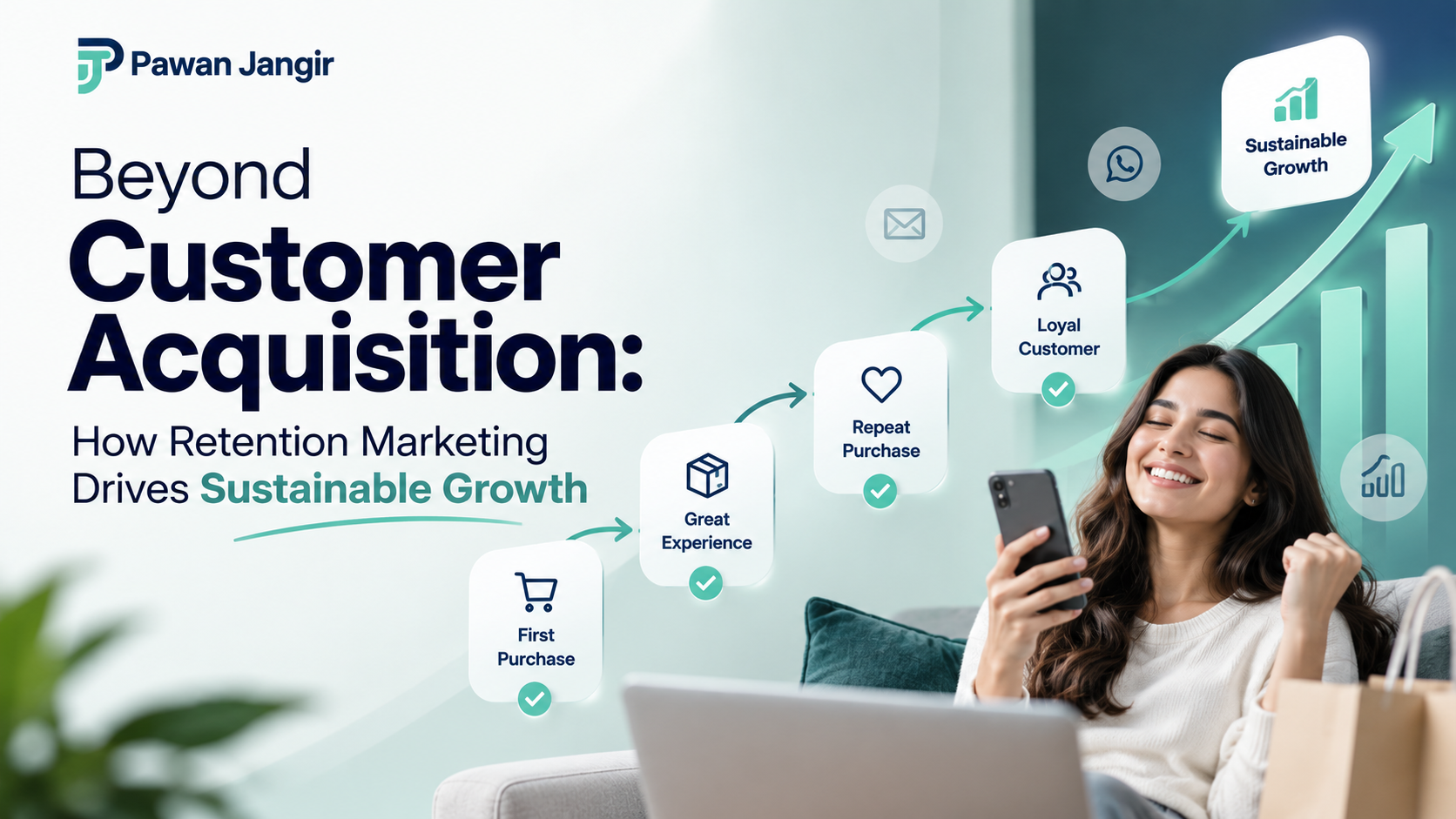
Beyond Customer Acquisition: How Retention Marketing Drives Sustainable Growth
Introduction: Growth Doesn’t End at the First Sale
For many businesses, digital marketing success is measured by how many new customers they acquire. Teams invest in Google Ads, Meta Ads, SEO, influencer campaigns, and other channels to bring more people to their websites.
But what happens after the first purchase?
If customers buy once and never return, businesses must continuously spend money acquiring new customers just to maintain revenue. Over time, this can put pressure on profitability, especially when advertising costs rise or competition increases.
This is where retention marketing becomes essential.
Retention marketing focuses on building lasting relationships with existing customers, encouraging repeat purchases, increasing customer lifetime value, and creating experiences that give people a reason to return.
Sustainable growth isn’t just about attracting more customers. It’s about making the most of the relationships a business has already built.
What Is Retention Marketing?
Retention marketing is a strategy designed to keep existing customers engaged with a brand and encourage them to continue buying from it.
Unlike acquisition marketing, which focuses on attracting new customers, retention marketing focuses on what happens after someone becomes a customer.
It can include:
Email marketing and personalized product recommendations
WhatsApp messages and customer engagement campaigns
Loyalty and rewards programs
Post-purchase communication and product education
Subscription and replenishment reminders
Win-back campaigns for inactive customers
Customer feedback, support, and personalized offers
For example, an e-commerce brand selling skincare products can send customers useful product-use instructions after a purchase, remind them when a product may need replenishing, and recommend complementary products based on their interests.
The goal isn’t to send more messages. It’s to deliver relevant communication that improves the customer experience and creates a natural reason to return.
Why Customer Retention Matters for Sustainable Growth
1. Increase Customer Lifetime Value
Customer lifetime value (CLV) estimates the revenue or profit a business can generate from a customer over the course of the relationship.
When customers purchase repeatedly, explore additional products, or remain subscribed for longer, their lifetime value can increase.
Consider a simple example:
A customer purchases a product worth ₹2,000 once. If that customer returns and makes three purchases of the same value over time, total revenue from that customer becomes ₹8,000.
This is illustrative revenue, not profit. Product costs, discounts, shipping, service costs, and marketing expenses still matter.
Retention marketing helps businesses build the conditions for repeat purchases through better experiences, timely communication, and relevant offers.
2. Improve Marketing Efficiency
Acquiring a customer requires investment in visibility, targeting, creative development, landing pages, and conversion optimization.
When customers return organically or through owned channels such as email, businesses may be able to generate additional orders without paying the full acquisition cost again.
However, retention is not free. Email platforms, loyalty incentives, customer support, discounts, and marketing operations also have costs.
The objective is to improve the economics of the customer relationship—not simply to move spending from one channel to another.
3. Build Brand Loyalty and Trust
Customers are more likely to consider returning when a brand consistently delivers on its promises.
Product quality, reliable delivery, responsive support, transparent policies, and useful communication all contribute to the customer experience.
Promotional messages alone cannot compensate for poor service or disappointing products.
Retention marketing works best when marketing reinforces a genuinely good customer experience.
4. Create More Predictable Revenue
For businesses with repeat-purchase products, subscriptions, or replenishment cycles, retention programs can support more consistent revenue.
Purchase-frequency analysis, repeat-order trends, subscription renewals, and cohort reporting can help teams identify patterns and make better decisions.
Revenue will never be completely predictable, but understanding existing customer behavior can make planning more informed.
Acquisition vs. Retention Marketing: Understanding the Difference
| Factor | Acquisition Marketing | Retention Marketing |
|---|---|---|
| Primary goal | Win new customers | Encourage existing customers to return |
| Target audience | Prospects and new buyers | Existing and past customers |
| Common channels | SEO, paid ads, social media, partnerships | Email, WhatsApp, loyalty programs, post-purchase journeys |
| Key metrics | CAC, conversion rate, qualified leads | Repeat purchase rate, retention rate, CLV, churn |
| Business impact | Expands the customer base | Develops the value of existing relationships |
Both approaches are important. Acquisition brings new customers into the business, while retention helps build long-term value from those relationships.
The right balance depends on the business model, product category, purchase frequency, margins, and growth stage.
Five Retention Marketing Strategies That Drive Growth
1. Build a Strategic Post-Purchase Journey
The customer experience should not stop when payment is completed.
A structured post-purchase journey can help customers feel confident about their decision and understand how to get the most from their purchase.
A practical sequence could include:
Immediately after purchase: Send an order confirmation with clear next steps.
After delivery: Share product instructions, setup guidance, or care tips.
After initial use: Request feedback or provide helpful educational content.
At an appropriate later stage: Recommend complementary products or replenishment when relevant.
The timing should reflect the product and customer journey. A skincare product, a sofa, and a software subscription require very different follow-up sequences.
2. Use Email and WhatsApp Personalization
Generic messages sent to every customer often become irrelevant and may lead to unsubscribes or blocked messages.
Segmentation allows brands to communicate based on meaningful differences in customer behavior, preferences, and purchase history.
For example, an e-commerce brand could create segments for:
First-time customers
Repeat buyers
High-value customers
Customers approaching their likely reorder date
Customers who have not purchased for an extended period
Email and WhatsApp can support different purposes. Email is useful for newsletters, product education, and automated journeys. WhatsApp can be effective for timely service updates and customer communication when customers have provided the appropriate consent.
Use clear opt-in practices, respect communication preferences, and follow applicable privacy and messaging rules.
3. Develop a Loyalty Program With Real Value
A loyalty program should give customers a meaningful reason to continue engaging with a brand.
Depending on the business, benefits might include reward points, exclusive access, member-only services, referral benefits, or perks based on purchase history.
Before launching a program, consider whether the rewards encourage genuinely incremental purchases or simply discount purchases customers would have made anyway.
Track participation, repeat purchase behavior, redemption costs, and contribution margin to evaluate whether the program is generating profitable value.
4. Recover Abandoned Carts and Re-Engage Inactive Customers
Not every customer who shows purchase intent will complete an order, and not every previous customer will return without a reminder.
Cart recovery can address common barriers such as unanswered product questions, unclear delivery information, or a forgotten checkout.
Win-back campaigns can reconnect with customers who have become inactive by offering useful information, relevant recommendations, or an incentive when appropriate.
Avoid repeatedly messaging people who have shown no interest. Set frequency limits, exclude customers who have opted out, and test whether the campaign generates incremental purchases.
5. Use Customer Data to Make Better Decisions
Retention becomes more effective when it is based on customer behavior rather than assumptions.
Analyze purchase frequency, average order value, product combinations, time between orders, returns, support issues, and customer feedback.
For example, if customers who buy a particular product frequently return for a complementary item, that relationship can inform cross-selling recommendations.
If customers stop purchasing after a disappointing delivery experience, the solution may be operational improvement rather than another promotional campaign.
The most valuable retention insight is not always another marketing opportunity. Sometimes it reveals a problem that needs to be fixed.
Retention Marketing Metrics Every Business Should Track
A retention strategy needs clear measurement. The most useful metrics depend on the business model and customer purchase cycle.
Customer Retention Rate
This measures the proportion of customers retained over a defined period, excluding new customers acquired during that period.
A common formula is:
Retention Rate = ((Customers at End − New Customers Acquired) ÷ Customers at Start) × 100
For example, if a business starts the month with 1,000 customers, ends with 1,100, and acquired 300 new customers during the month, its retention rate is:
[
\frac{1,100-300}{1,000}\times100=80%
]
The definition of an active or retained customer should be consistent with the business model.
Repeat Purchase Rate
This measures the share of customers who have purchased more than once within a defined period.
Repeat Purchase Rate = (Customers With Multiple Purchases ÷ Total Customers) × 100
It is particularly useful for e-commerce businesses, although the observation period should match the product’s typical repurchase cycle.
Customer Acquisition Cost (CAC)
CAC estimates the cost of acquiring a new customer.
A useful calculation divides the relevant acquisition costs by the number of new customers acquired during the same period. Businesses should define which costs are included and avoid comparing inconsistent calculations.
Customer Lifetime Value (CLV)
CLV estimates the value generated by a customer over the relationship.
For strategic decisions, contribution-margin-based CLV is often more useful than revenue-only CLV because it accounts for costs associated with serving the customer.
Churn Rate
Churn measures the proportion of customers who stop being customers over a defined period. It is particularly relevant for subscriptions and recurring-revenue businesses.
For businesses where customers purchase irregularly, an inactive customer should not automatically be considered lost. The definition should reflect normal buying behavior.
Campaign Incrementality
Open rates, clicks, and attributed revenue can help evaluate campaign performance, but they do not necessarily prove that a campaign caused additional sales.
Where practical, use holdout groups or controlled tests to compare customers who receive a campaign with similar customers who do not. This helps estimate whether the campaign generated incremental purchases.
How to Build a Retention Marketing Strategy: A Practical Framework
Businesses don’t need dozens of automated campaigns to get started. A focused strategy can begin with a few important customer journeys.
Step 1: Understand current customer behavior. Identify how many customers return, how long they take to make another purchase, and which products or services encourage repeat business.
Step 2: Segment the customer base. Separate first-time buyers, repeat customers, high-value customers, and inactive customers where the data supports these distinctions.
Step 3: Identify the biggest opportunity. Determine whether the priority is improving the post-purchase experience, increasing repeat purchases, reducing subscription churn, or re-engaging inactive customers.
Step 4: Create relevant customer journeys. Start with a small number of well-designed flows, such as post-purchase education, replenishment reminders, or a carefully timed win-back campaign.
Step 5: Measure business outcomes. Track repeat purchases, retention, contribution margin, unsubscribe rates, and incremental revenue—not just message engagement.
Step 6: Test and improve. Experiment with timing, messaging, segmentation, and incentives. Use the results to improve the experience rather than increasing message frequency indiscriminately.
Common Retention Marketing Mistakes to Avoid
Even well-funded brands can struggle with retention when their strategies focus on short-term engagement rather than long-term customer value.
Common mistakes include:
Sending excessive promotional messages
Offering discounts without measuring profitability
Using the same communication for every customer
Ignoring product quality, delivery, and customer service
Measuring attributed revenue without testing incrementality
Trying to force repeat purchases when a product is not naturally replenished
Failing to respect consent, unsubscribe requests, and customer preferences
Retention marketing should make the customer relationship more valuable for both sides. It should never rely on simply increasing the number of messages sent.
The Role of Retention Marketing in Sustainable Business Growth
Acquisition and retention should not operate as separate marketing functions.
SEO, paid advertising, social media, and content can introduce people to a brand. A well-designed website and customer experience can convert that interest into a purchase. Post-purchase communication, product value, customer service, and retention campaigns can then help build a longer-term relationship.
When these activities work together, businesses can make better use of customer insights, improve the customer journey, and make more informed marketing investment decisions.
The goal is not to reduce acquisition spending at any cost. It is to build a business in which acquiring customers and serving existing customers both contribute to sustainable growth.
Conclusion
Customer acquisition helps a business grow its customer base, but long-term growth depends on what happens after the first conversion.
Retention marketing gives businesses a structured way to encourage repeat purchases, improve customer lifetime value, strengthen loyalty, and understand the economics of their customer relationships.
Start by identifying where customers drop off, what prevents them from returning, and which experiences would genuinely make their next purchase easier or more valuable.
Then build targeted journeys, measure the results, and improve continuously.
Sustainable growth isn’t just about winning the next customer. It’s about giving existing customers a reason to stay.
Frequently Asked Questions
1. What is retention marketing?
Retention marketing is the process of engaging existing customers and encouraging them to continue buying, renewing, or interacting with a business through relevant communication and positive customer experiences.
2. Why is customer retention important for e-commerce businesses?
Retention can help e-commerce businesses generate repeat orders, increase customer lifetime value, and improve the efficiency of marketing investment. Its impact depends on product demand, margins, customer experience, and the cost of retention activities.
3. Which channels are best for retention marketing?
Email, WhatsApp, loyalty programs, post-purchase communication, and personalized website experiences can all support retention. The right combination depends on the audience, purchase cycle, customer consent, and business model.
4. What is a good customer retention rate?
There is no single ideal rate for every business. Retention varies across industries, product categories, subscription models, and measurement periods. Compare performance with relevant industry benchmarks and the business’s own historical results.
5. How can a business measure retention marketing ROI?
Compare the incremental contribution generated by retention activities with the costs of campaigns, platforms, incentives, and operations. Controlled tests can help distinguish additional purchases caused by a campaign from purchases that would have happened anyway.
6. Is retention marketing suitable for small businesses?
Yes. Small businesses can begin with simple post-purchase follow-ups, helpful customer education, personalized service, feedback requests, and relevant reminders. Sophisticated automation is not required to start building stronger customer relationships.